
One of the hardest parts of starting a bookkeeping business isn’t learning how to reconcile an account or close the books.
It’s deciding what to charge.
You may see one bookkeeper charging $30 an hour, another charging $75, and someone else selling monthly packages for $1,000 or more.
So what are you supposed to charge?
The answer isn’t one magic number. Your bookkeeping prices need to account for your experience, the amount of work involved, your business expenses, the complexity of the client, and—most importantly—whether the price actually allows you to build a profitable business.
Let’s break it down.
Why There Isn’t One Standard Bookkeeping Rate
It’s tempting to search for the “average bookkeeping rate” and simply choose a number somewhere in the middle.
The problem is that two bookkeeping clients can require dramatically different amounts of work.
Consider Client A:
- One checking account
- One credit card
- 75 transactions per month
- No payroll
- No inventory
- Clean, organized records
Now compare that with Client B:
- Three bank accounts
- Four credit cards
- 700 monthly transactions
- Payroll
- Sales tax
- Inventory
- Accounts payable
- Monthly reporting
- Frequent questions
Calling both of these “monthly bookkeeping” doesn’t mean they should cost the same amount.
That’s why your pricing should start with the workload and complexity—not simply what another bookkeeper charges.
Start by Calculating the Hourly Rate Your Business Actually Needs
Even if you eventually want to offer fixed monthly packages, knowing your internal hourly rate is incredibly useful.
Start with your desired annual income.
Then account for your business expenses.
These might include:
- Bookkeeping software
- Professional liability insurance
- Website hosting
- Marketing
- Continuing education
- Certifications
- Payment processing fees
- Contractors or employees
- Office expenses
- Taxes
Next, consider how many hours you can realistically spend doing client work.
This is where new business owners can accidentally underprice themselves.
Working 40 hours per week does not mean you have 40 billable hours available.
You also have to run your business.
That includes marketing, discovery calls, invoicing, answering emails, managing your website, onboarding clients, continuing education, administrative work, and countless little tasks that aren’t directly billable.
If you can realistically dedicate 20–25 hours per week to client work, your pricing needs to generate enough revenue within those hours to support the entire business.
An Example
Suppose you want your bookkeeping business to eventually provide $75,000 per year in owner compensation.
You estimate another $12,000 per year in business expenses.
That already means the business needs to generate at least $87,000.
But you’re not finished.
You may also need to account for taxes, time off, non-billable work, and a profit cushion.
Suddenly, charging $30 or $40 per hour simply because it feels like a reasonable starting rate may not support the business you’re trying to build.
This is why I prefer working backward from your financial goals rather than choosing a rate based entirely on what other bookkeepers are charging.
Hourly Pricing vs. Monthly Pricing
There are two common ways independent bookkeepers price their services.
Hourly Pricing
You track the time you spend working for the client and invoice based on your hourly rate.
For example:
10 hours × $75/hour = $750
Hourly pricing can be useful when you’re new because you may not know exactly how long certain clients will take.
It can also work well for:
- Cleanup projects
- Catch-up bookkeeping
- Consulting
- Special projects
- Unpredictable work
The downside is that your income is directly tied to your time.
As you become faster and more efficient, you may actually earn less for completing the exact same work.
Fixed Monthly Pricing
With monthly pricing, the client pays an agreed-upon amount for a clearly defined scope of work.
For example, a client might pay $750 per month for:
- Monthly bookkeeping
- Bank and credit card reconciliations
- Month-end close
- Financial statements
- One monthly meeting
This creates predictable revenue for your business and predictable expenses for your client.
But fixed pricing only works well when you understand how much work you’re agreeing to perform.
That’s why estimating the client’s monthly hours is still valuable—even if the client never sees an hourly rate.
What Should Affect a Client’s Monthly Price?
Transaction count matters, but it shouldn’t be the only factor.
Consider the entire engagement.
Number of Accounts
More checking accounts, savings accounts, credit cards, loans, and payment processors generally mean more reconciliation work.
Transaction Volume
A business with 80 transactions per month usually requires less work than one processing 1,000.
Payroll
Are you simply recording payroll entries, or are you responsible for processing and reviewing payroll?
Those are very different scopes.
Accounts Payable and Accounts Receivable
Managing vendor bills, customer invoices, collections, or payment runs can add significant time and responsibility.
Sales Tax
If you’re preparing or filing sales tax returns, include that work in your pricing.
Inventory
Inventory-based businesses can require considerably more reconciliation and month-end work than simple service businesses.
Reporting
Standard financial statements are different from customized reporting, cash-flow analysis, dashboards, or management reports.
Communication
Some clients send everything you need on time.
Others require repeated follow-ups.
Your pricing should account for the amount of client management an engagement requires.
Don’t Forget About Complexity
Imagine two clients that each take approximately eight hours per month.
One has clean books, straightforward transactions, and responds quickly whenever you have a question.
The other has complicated transactions, missing documentation, constant questions, and multiple people involved in the accounting process.
Those clients don’t necessarily deserve the same price simply because the estimated hours are identical.
Complexity has value.
So do responsibility, expertise, responsiveness, and risk.
Consider Adding a Profit or Risk Cushion
If your estimated workload suggests a client will take approximately eight hours per month, I wouldn’t necessarily price the engagement at exactly:
8 hours × your hourly rate.
Estimates aren’t perfect.
A month might contain unexpected transactions. The client may need additional communication. A reconciliation may take longer than anticipated.
Building some cushion into your pricing helps prevent every unexpected 30-minute task from eating into your margin.
Watch Out for Scope Creep
One of the easiest ways to turn a profitable bookkeeping client into an unprofitable one is allowing the scope to continuously expand without changing the price.
Suppose your original package includes monthly bookkeeping and reconciliations.
Six months later, you’re also:
- Paying bills
- Creating invoices
- Answering weekly reporting questions
- Handling sales tax
- Fixing payroll issues
- Attending additional meetings
But the client is still paying the original monthly price.
That’s a pricing problem.
Your engagement agreement should clearly explain what’s included, what’s excluded, and how additional work will be priced.
What About Cleanup Work?
Be careful about including significant historical cleanup in a normal monthly bookkeeping package.
If a new client hasn’t reconciled their books for eight months, fixing those eight months is a separate project from maintaining clean books going forward.
Consider pricing cleanup and catch-up work separately.
Once the books are current, the client can transition into your normal monthly service.
Your Pricing Can Change
Your first bookkeeping rate doesn’t have to be your rate forever.
As you gain experience, improve your systems, specialize in certain industries, increase demand, and better understand how long engagements actually take, your pricing should evolve.
You may start with hourly work while gathering data.
Later, you might transition to fixed monthly pricing.
Eventually, you may develop clearly defined packages or minimum monthly engagements.
That’s normal.
The important part is paying attention to your numbers.
A Simple Formula for Pricing a Bookkeeping Client
When evaluating a prospective client, start with:
Estimated Monthly Hours × Your Sustainable Hourly Rate
Then consider:
+ Complexity
+ Scope
+ Risk and responsibility
+ Communication requirements
+ Profit cushion
The result gives you a much stronger starting point for a monthly price than simply asking, “What do other bookkeepers charge?”
Stop Guessing What to Charge
Pricing was one of the areas I found surprisingly difficult to research when building a bookkeeping business.
There was plenty of advice telling bookkeepers to “charge their worth,” but much less information explaining how to turn income goals, available hours, client workload, and business expenses into an actual price.
That’s why I created the Bookkeeper Pricing & Profit Calculator for Bookkeeper Launch Studio.
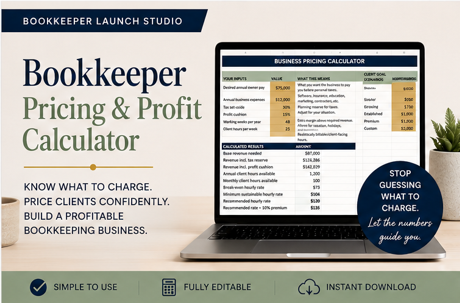
The editable workbook helps you:
- Calculate your break-even hourly rate
- Find your minimum sustainable rate
- Calculate a recommended pricing rate
- Estimate prospective client pricing
- Adjust for complexity and scope
- Build monthly bookkeeping packages
- See how many clients you need to reach your income goals
Instead of picking a number because it sounds right, you can start with the numbers behind your business.
Because the goal isn’t simply to get bookkeeping clients.
It’s to build a bookkeeping business that is actually profitable.